


Introduction
Have you ever rested all weekend, only to wake up Monday feeling as drained as Friday morning? If recognizing the early signs of burnout feels confusing, you’re not alone.
As a coach who has experienced burnout firsthand, I’ve guided a good number of people through recognizing these early signs of burnout and recovering. I’ve seen this pattern repeatedly: people talk about fatigue, stress, or anxiety, convinced a good break will fix it.
But when rest doesn’t recharge you the way it should for normal tiredness, it signals something deeper is happening. That’s where the MABI (Mputu Advanced Burnout Indicator) comes in. It’s a practical framework I developed to help spot those early signs of burnout before they escalate into full crisis. In this article, I’ll walk you through the four stages so you can check in with yourself and recognize where you are.
The Problem:
Traditional Tests Miss Early Signs of Burnout
Let’s start with what burnout is: a state of chronic stress that leads to physical, emotional, and mental exhaustion. Full definition here
The challenge? Most people don’t realize they’re experiencing early signs of burnout until it’s severe.
Traditional assessment tools like the Maslach Burnout Inventory (MBI) are valuable for diagnosing full burnout, but they typically catch it late, when you’re already deep into crisis mode.
What gets missed is the “gray zone”, that critical in-between state where you’re not okay, but not completely broken down either. You’re functioning, going to work, managing responsibilities, but suffering quietly inside. Most people don’t realize they’re in danger until they’ve crossed into full burnout.
This gray zone insight came from my own recovery journey (I’ve met with multiple specialists and other people struggling with burnout). Regularly, I kept hearing people say they had burnout without being sure, without diagnostic. And just as often, I’d see people dismiss real burnout symptoms as “just being tired,” pushing through when they desperately needed intervention.
As I tried to understand where the border was between deep fatigue and actual burnout, I realized: there is no simple border. There’s an entire area in between with its own distinct characteristics, a zone where you’re not just tired, but not completely burned out either. That’s the gray zone.
Most burnout frameworks miss it entirely because they’re looking for a line when they should be mapping a spectrum.
Here’s what makes MABI different: it shows you the complete picture, starting with a stage that comes before burnout symptoms even begin.
MABI maps four stages:
- Deep Fatigue (Stage -1)
- Pre-Burnout or the gray zone (Stage 1)
- Burnout (Stage 2)
- Acute Crisis (Stage 3)
The inclusion of Stage -1 is crucial, it’s the recoverable warning period that other tools ignore, giving you a chance to course-correct before entering burnout territory.
MABI isn’t a medical diagnosis, I’m a coach, not a doctor. It is a practical framework built from my own recovery journey and strong experience supporting high-performers like expats and leaders. In this article, I’ll show you what each stage looks like so you can recognize where you are.
For professionals wanting to implement MABI with clients, a comprehensive guide with detailed protocols is coming.
The 4 Stages of Burnout:
From Deep Fatigue to Crisis
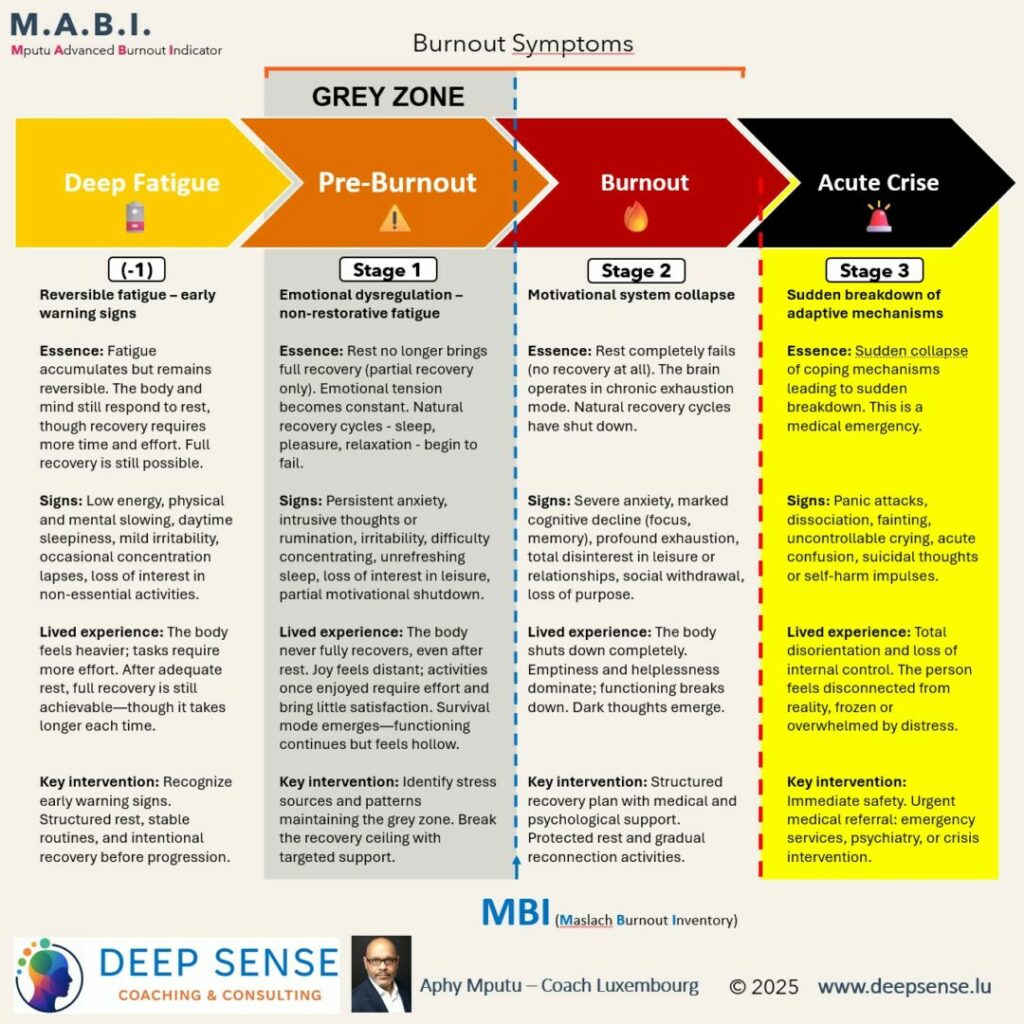
Burnout doesn’t strike suddenly; it’s a gradual slide. MABI visualizes this as a progression through four distinct stages, with the gray zone covering Pre-Burnout.
Understanding this progression is key to early intervention.
Deep Fatigue sits at Stage -1 because it comes before burnout starts. Think of it as “Stage Zero”, your last exit ramp before entering burnout territory.
Once you hit Stage 1, you’ve crossed into the gray zone where burnout has begun.
Let me break down what each stage looks like, with real examples from people I’ve supported (anonymized, of course).
Stage -1: Deep Fatigue : The Recoverable Warning
Recovery capacity: Rest still works, it just takes more intentionality and time. A person might need a couple days or more to recover completely.
What’s happening: Fatigue has accumulated, but your body and mind still respond to rest. Recovery feels shorter-lived each time, and you need to be more strategic about how you rest, but you can still bounce back fully.
Key symptoms:
• Low energy that improves with adequate rest
• Slower thinking or physical movement
• Daytime sleepiness or need for more sleep
• Mild irritability or impatience
• Losing interest in non-essential activities
• Occasional focus lapses
What it feels like: Tasks feel heavier, and your body drags. Simple things require more effort than they used to. But after a solid weekend or a few intentional rest days, you feel somewhat renewed, though those rebounds depend increasingly on truly unplugging.
Example: A leader I coached was skipping hobbies because everything felt harder, but a true long weekend completely recharged her.
If you’re here, it’s not burnout yet. You’re in the warning zone. Structured rest, better boundaries, and energy management can turn this around before it progresses.
Stage 1: Pre-Burnout (The Gray Zone) – Where Burnout Begins
Recovery capacity: Rest fails but not entirely. Your system won’t recharge to its max but only to a certain level, maybe 60-70% at best, no matter what you do.
What’s happening: This is where the gray zone starts, and where burnout symptoms really begin. Rest no longer fully restores you. You can take a vacation, sleep extra hours, or do activities you once enjoyed, but you never quite get back to 100%. There’s an invisible ceiling on your recovery. Emotional tension sticks around, and your natural recovery mechanisms (sleep, leisure, social connection) start failing you.
Key symptoms:
• Regular anxiety without clear triggers
• Pics of rumination or worry
• Unrefreshing sleep regardless of duration
• Irritability over small things
• Loss of interest or pleasure in activities (anhedonia)
• Poor concentration and memory issues
• Partial shutdown in motivation
• Feeling like you’re in “survival mode”
What it feels like: Even after rest, your battery stays low. Activities that used to bring joy now require effort and give little satisfaction. You keep going, showing up at work, fulfilling responsibilities, but inside, you’re running on empty. The phrase “I’m fine” becomes your default, but you’re not fine. You’re functioning despite suffering.
Example: An expat professional told me her weekends were filled with worry about Monday. Even her favourite hobbies felt flat. She’d go through the motions, but the spark was gone. Rest gave her just enough energy to get through the week, but she never felt truly recharged. She was trapped at 60-70% capacity, until it became less.
This stage is critical because symptoms mirror full burnout but at a manageable level. You’re still working, still pushing, but the cost is mounting. This is where intervention matters most.
Stage 2: Burnout – Complete Collapse
Recovery capacity: Rest completely fails. At best, you reach symbolically 10%, like a phone that only survives for one day if you never use it and keep it in airplane mode. You’re technically on, but completely non-functional.
What’s happening: The collapse hits. Chronic stress has overwhelmed your system, and motivation crumbles. Your brain essentially traps you in exhaustion mode. No amount of rest, vacation, or self-care provides relief. You’re running on empty, and there’s nothing left to draw from.
Key symptoms:
• Severe, unrelenting exhaustion
• Heightened anxiety or panic
• Sharp cognitive decline (focus, memory, decision-making)
• Total disinterest in relationships or leisure
• Social withdrawal and isolation
• Emotional numbness or emptiness
• Loss of purpose or meaning
• Feeling detached from yourself
What it feels like: Emptiness takes over. You feel like a shell, unable to connect or find meaning. Your mind might push you to keep going, but your body has quit. Simple tasks feel impossible. Getting out of bed becomes an achievement.
Here, the symptoms that were present in Stage 1 intensify to paralyzing levels. Daily functioning breaks down, and you can’t push through anymore.
Stage 3: Acute Crisis – Emergency Breakdown
Nature: This is a separate category, a sudden, severe breakdown where your adaptive systems fail completely.
What’s happening: Total loss of control over emotions and body. This is a medical emergency requiring immediate professional intervention.
Key symptoms (Examples):
• Panic attacks or uncontrollable anxiety
• Dissociation or feeling disconnected from reality
• Physical collapse (fainting, severe tremors)
• Uncontrollable crying or emotional outbursts
• Confusion or inability to think clearly
• Suicidal thoughts or self-harm ideation
What it feels like: Total disorientation. You’re either frozen or completely overwhelmed, unable to function or make sense of anything. The world feels surreal, and you’ve lost your grip on reality.
This stage shows as someone hitting an absolute wall, unable to get out of bed, make decisions, or see any way forward. If you or someone you know is experiencing these symptoms, seek professional help immediately.
The gradient nature:
MABI emphasizes that symptoms appear across multiple stages, but with different intensity.
Pre-burnout has many of the same symptoms as burnout, like anxiety and loss of pleasure, but at milder levels. You’re suffering but still functioning. In full burnout, these symptoms become unbearable and halt everything.
Key Burnout Symptoms: Anxiety and Loss of Pleasure
Burnout manifests through many symptoms: physical exhaustion, cognitive decline, social withdrawal, sleep problems, and more. But two patterns are particularly revealing for early detection and help many people realize they’ve crossed from normal fatigue into burnout territory.
Persistent Anxiety:
This isn’t worry about a specific thing, it’s a constant hum of tension that follows you everywhere, even in calm moments. Weekends don’t dial it down. You arrive Monday morning as stressed as you were Friday evening.
If rest eased this anxiety, it would just be normal stress or fatigue. When it doesn’t, you’re likely in Pre-Burnout or beyond. This anxiety intensifies as you move through stages, manageable but annoying in Stage 1, overwhelming in Stage 2, and potentially triggering panic attacks in Stage 3.
Anhedonia (Loss of Pleasure):
You lose the ability to feel joy or satisfaction in things that used to light you up.
Hobbies feel like obligations. Time with loved ones feels effortful. Small wins at work feel hollow.
It’s not depression exactly – though it can overlap – it’s your nervous system’s way of conserving energy under chronic stress. In Pre-Burnout, you notice the flatness but push through. In Burnout, even trying feels pointless.
These aren’t the only symptoms that matter, but they’re particularly useful as teaching examples.
Everyone’s burnout looks slightly different, but these patterns appear consistently enough to serve as reliable warning signs. They work alongside the physical, cognitive, and social signs described in each stage to give you a complete picture.
Burnout Self-Assessment: Identify Your Stage
Here’s a practical self-check based on the MABI framework. This isn’t a medical diagnosis—just a starting point to help you reflect on where you might be. Answer yes or no honestly, thinking about patterns over the past few weeks, not isolated incidents.
Deep Fatigue (Stage -1) Indicators:
- Do you need more intentional effort and time to recover than you used to?
- Does it take several days of complete rest to feel fully recharged?
- Are you skipping hobbies or social activities because everything takes more energy?
- Do you experience occasional focus lapses or daytime sleepiness?
Pre-Burnout (Stage 1) Indicators:
- Do weekends or breaks leave you feeling only partially recharged—maybe 60-70% at best?
- Is anxiety present throughout your day, even without clear triggers?
- Do activities you once enjoyed now feel flat, effortful, or meaningless?
- Is your sleep unrefreshing no matter how many hours you get?
- Are you irritable over small things more often than usual?
- Do you find yourself ruminating or worrying constantly, unable to switch off?
- Is focusing or remembering information significantly harder than it used to be?
Burnout (Stage 2) Indicators:
- Does rest provide virtually no recovery – you stay exhausted no matter what you do?
- Do you feel completely detached from your purpose, work, or relationships?
- Have you withdrawn from most social or leisure activities?
- Do you feel emotionally numb or empty most of the time?
Crisis (Stage 3):
The “Crisis” stage is the only one that leaves absolutely no doubt concerning the emergency. So in this case the crisis is the indicator.
Scoring Guide:
2+ Yes in Deep Fatigue section only: You’re likely in Stage -1. Good news—this is fully reversible. Implement structured rest, stronger boundaries, and monitor your symptoms. Catch it now before it progresses.
3+ Yes in Pre-Burnout section: You’re in the gray zone (Stage 1). This is where burnout begins, and where intervention matters most. Prioritize recovery strategies now. Consider reaching out to a coach or therapist for support.
3+ Yes in Burnout section: You’re likely in Stage 2. This requires significant action and professional support – both coaching and potentially medical care. Recovery is possible but will take time and dedicated effort.
Want a more detailed analysis for yourself ? The complete MABI assessment is available during physical visit only at this point.
Conclusion
Spot the Early Signs of Burnout Before It’s Too Late
Burnout sneaks up gradually, but frameworks like MABI help you catch those early signs – recognizing when rest stops working fully, when anxiety becomes constant, when joy fades.
As someone who’s walked this path and guided many others through it, I know that recognizing the gray zone changes everything.
The key insight?
Deep Fatigue (Stage -1) is your warning, the recoverable stage before burnout actually begins.
Most tools miss this entirely. Once you cross into Pre-Burnout (Stage 1), you’ve entered the gray zone where burnout has started, but intervention is still highly effective.
Wait until Stage 2, and recovery becomes much harder and longer.
You’re not weak for experiencing this. You’re human under sustained pressure. The earlier you recognize where you are, the faster and easier your recovery will be.